
Core Detailed Parameters
Dimension Specifications
Standard width 3-12m, height 2.5-6m (customizable ultra-wide/extra-high doors up to 30m wide), matching door opening size and passage equipment (such as forklifts, trucks).
Opening and Closing Speed
High-speed doors 0.8-1.5m/s (reducing heat and cold loss and passage waiting time), roller shutters 0.15-0.3m/s, sliding doors 0.3-0.5m/s.
Wind Resistance Grade
Designed based on installation environment (indoor/outdoor), outdoor doors have a wind resistance grade of ≥10 (able to withstand wind speeds of 24.5-28.4m/s), preventing door deformation.
Insulation Performance
Insulation door thermal conductivity ≤0.3W/(㎡·K), commonly filled with polyurethane foam (density 40-60kg/m³), suitable for cold chain and constant temperature workshops.
Protection Grade
IP54 and above (dustproof and splash-proof), some explosion-proof doors reach Ex d IIB T4Gb grade, suitable for chemical, oil and gas and other hazardous scenarios.
Service Life
Under normal maintenance, the door structure has a lifespan of 8-15 years, and the core hardware components have a lifespan of 5-8 years. In high-frequency usage scenarios, the hardware configuration level needs to be upgraded.
Mainstream Door Materials
Material selection is centered on “strength, durability, and scene adaptability”, with significant differences in materials for different types of doors:
Roller Shutters
Panel Materials
Use 0.3-0.8mm thick color-coated steel plates (with anti-corrosion coating on the surface, strong weather resistance) or aluminum alloy plates (lightweight, suitable for door openings without load-bearing restrictions), and some high-end models use stainless steel plates (anti-corrosion, suitable for food and chemical workshops).
Filling Materials
Hollow shutter panels are filled with polyurethane foam (insulation) or rock wool (fireproof, fire resistance limit ≥1.5h), meeting special scene requirements.
Sliding Doors/Sliding Lift Doors
Door Panel Materials
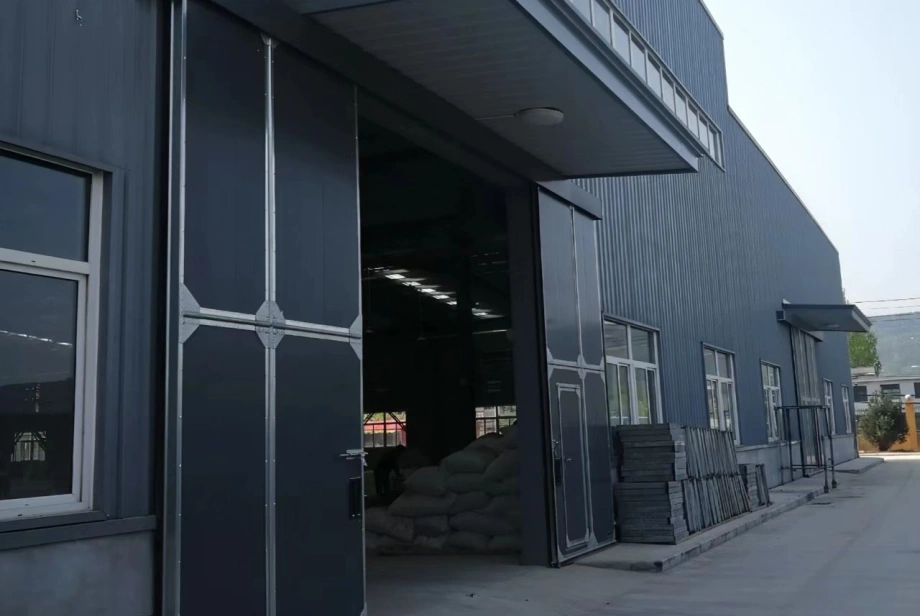
Outer layer is 0.8-1.2mm thick galvanized steel plate (impact-resistant), inner layer is 0.5mm thick steel plate, middle filled with 50-100mm thick polyurethane foam (insulation + soundproofing), door edges are equipped with sealing strips (reducing air leakage).
Frame Materials
Use 60×80mm or 80×100mm cold-rolled steel square tubes (surface spray-painted for rust prevention), strong load-bearing capacity, suitable for large-sized doors.
High-Speed Doors
Door Curtain Materials
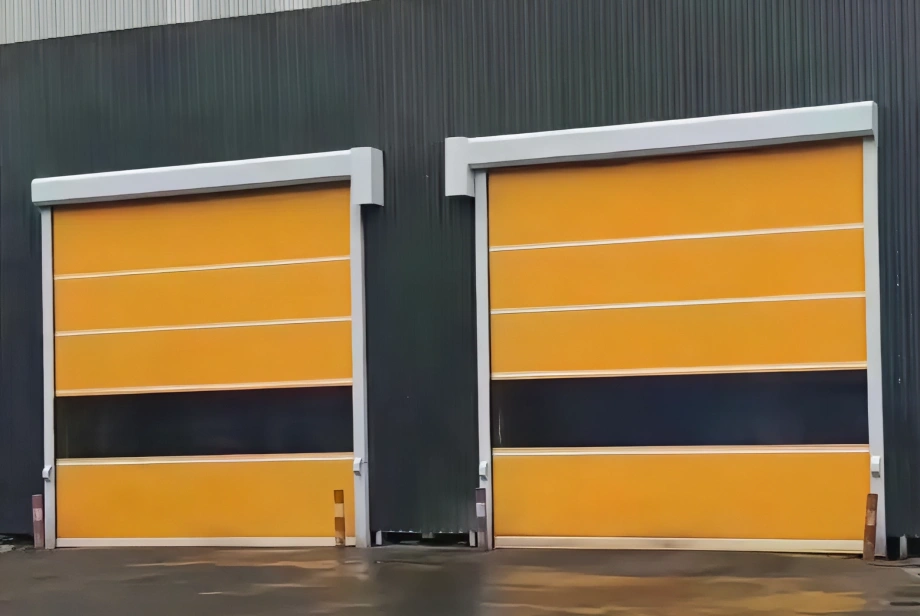
For high-frequency usage scenarios, use PVC knife-edge fabric (thickness 0.8-1.2mm, tear-resistant, wear-resistant, usable in -30℃ to 70℃ environments); for food/clean workshops, use antibacterial PVC fabric (meets food-grade standards); for explosion-proof scenarios, use flame-retardant PVC fabric (self-extinguishing when away from fire).
Hardware System Features
The hardware of industrial doors is the “core of durability”, needing to adapt to high-frequency opening and closing, load-bearing, and harsh environments. Key components include:
Drive Motor
Noise ≤65dB
Use three-phase asynchronous motors (power 0.75-3kW, large torque, suitable for heavy door bodies) or DC servo motors (specific for high-speed doors, smooth start and stop, noise ≤65dB).
Overheat protection
Equipped with overheat protection (automatically stops when temperature ≥120℃) and manual emergency function (can manually open the door when power is off), avoiding faults affecting passage.
Guide Rails and Pulleys
Guide Rails
Use cold-rolled steel profiles (thickness 3-5mm, smooth surface, reducing friction), some high-end models use aluminum alloy guide rails (lightweight, anti-corrosion), with wear-resistant strips on the inner side (extending pulley lifespan).
Pulleys
Use nylon pulleys (quiet, wear-resistant) or stainless steel pulleys (load-bearing ≥50kg/each, suitable for heavy door bodies), some with bearing design (smoother opening and closing, lifespan increased by 30%). 3. Locks and Limiting Devices:
Locks
The exterior door is equipped with a mechanical anti-theft lock (anti-picking), while the interior door is fitted with an electromagnetic lock (locked when powered on, unlocked when power is off, suitable for automated control).
Limiting Devices
Photoelectric limiters (accuracy ±5mm, preventing door body collision) or mechanical limiters (dual protection, preventing photoelectric faults) are adopted to ensure accurate opening and closing positions.
Sealing and Buffering
EPDM sealing strips
The top and sides of the door body are equipped with EPDM sealing strips (durable, usable from -40°C to 120°C, with good sealing performance), and the bottom is fitted with airbag-type sealing strips (automatically adhering to the ground, dust-proof, insect-proof, and heat-insulating).
Buffering devices
Buffering devices (hydraulic or spring type) are installed at both ends of the door body to reduce shock during start and stop, and extend the service life of the door body and hardware.